Bolinas Film Festival: What Actually Changes in Town This Week
September 10, 2026
September 10, 2026
On a September night with the moon nearly full, two filmmakers sat around a fire in an open field in Bolinas, in the middle of one of their regular creative retreat weekends. One of them, Enzo Resta, had been part of this town since 1967, when his mother was helping write the Bolinas Community Plan and his father was running an avant-garde circus that performed alongside the town's poets and dancers, as Marin Magazine reported. The other, Chealy Jean, was a Los Angeles-based filmmaker and producer. By the end of that night they had decided to build a film festival.
This September, for the fourth year running, the Bolinas Film Festival will bring filmmakers from as far as Brazil, Greece and Iran to a converted 19th-century church for four days of screenings.
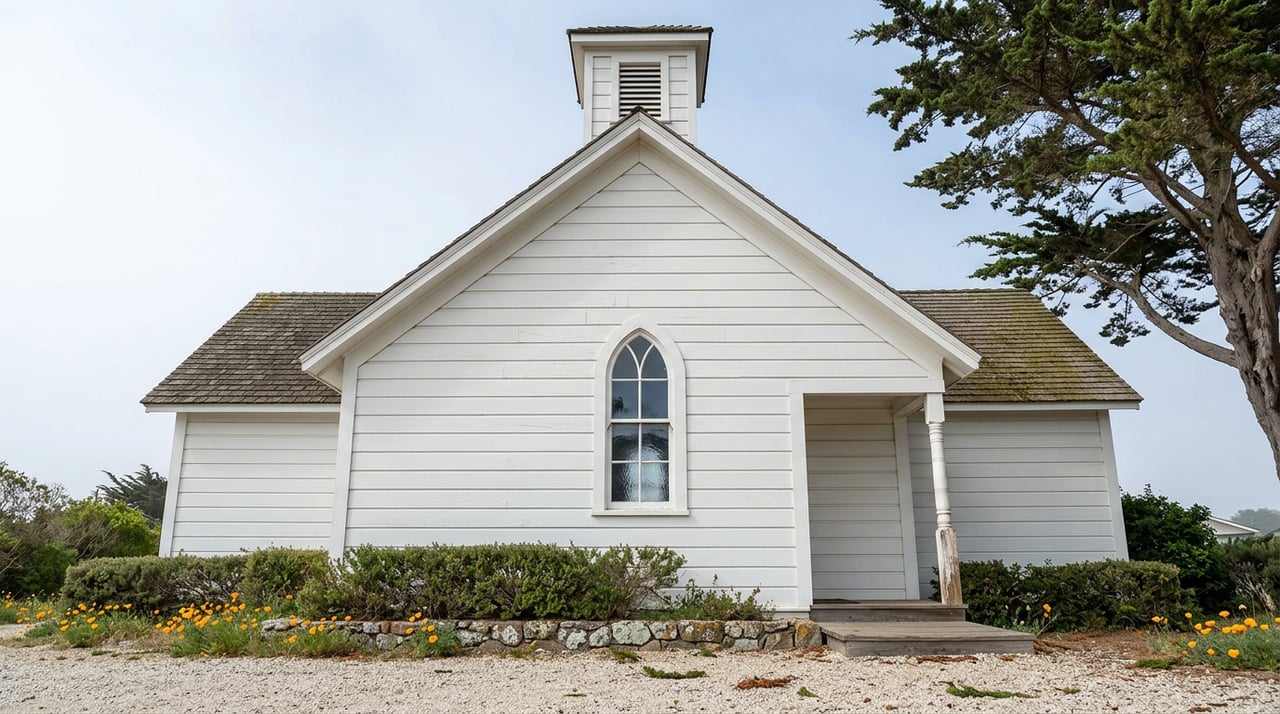
The festival's main stage is Calvary Presbyterian Church at 5 Brighton Avenue, a building with its own local history: it was cut in half and moved by horse and carriage into downtown Bolinas from a site closer to the old schoolhouse. For the festival's four days, running September 17 through 20 this year, that sanctuary becomes the Starlight Theater. Organizers install blackout blinds, a pulley system to hoist a full-size screen, and a Meyer Sound system built for a room that was never designed to hold an audience watching a movie. When the festival ends, the equipment comes down and the building goes back to being what it was before.
The festival's local footprint extends beyond the church, beginning with a town-run preview.
Before the festival's paid programming even starts, the town runs its own warmup. On Saturday, September 12, Smiley's Saloon hosts a free table read of the Coen brothers' "Fargo," performed not by actors but by local voices, open to anyone who walks in. It's a tradition: last year's preview was a table read of "Goodfellas" on Smiley's patio, followed by a free, family-friendly outdoor screening of the 2024 Bob Marley biopic in the town park. No tickets or pass are required for the local table read before festival visitors arrive.
By the time the paid festival opens, Resta has usually made clear how much bigger the official program has grown. As the Pacific Sun reported, Resta described last year's third annual edition:
"We are screening over 30 films, many with filmmakers in attendance."
That kind of scale, arriving in a town with one 24-hour gas station and two general stores, only works because the town supplies the labor and the buildings, and the visiting films supply the rest.
The festival's programming leans hard on outside work: a 2024 documentary on Frida Kahlo, A24's family film "The Legend of Ochi," Payal Kapadia's "All We Imagine as Light" all screened during last year's third annual edition. But the festival also carries a recurring block built entirely from its own address book. A section labeled simply "Hyper Local" is reserved for short films about, or made by, Bolinas residents. In the most recent program that block included a screening of "Descartes," an 11-minute experimental film from 1968 by Bolinas poet Joanne Kyger, shown at Bolinas Gallery on Wharf Road with a seat count so small the tickets sold out, leaving only standing room.
That same edition carried the connective tissue further than one poet's short film. A documentary on Bolinas painter Arthur Okamura, known for his work in screen printing and painting, was directed by Walter Murch Jr., son of longtime Bolinas resident Walter Murch, the Oscar-winning film editor. The festival didn't import that credibility. It was already living two doors down.
For a resident trying to plan around festival traffic, the useful question isn't what the festival adds. It's what stays exactly the same underneath it.
| During the festival | Rest of the year |
|---|---|
| Calvary Presbyterian Church becomes the Starlight Theater | Reverts to its regular use once equipment comes down |
| Parking on Wharf Road and Brighton Avenue is tight; carpooling is the standing advice | Parking is limited in Bolinas year-round |
| Bo Gas station runs 24/7 | Same, unchanged |
| Bolinas General Store (40 Wharf Road) and Bolinas People's Store (14 Wharf Road) close around 6:30 p.m. | Same hours, festival or not |
| Coast Café, Eleven, and Smiley's serve food until 8 or 9 p.m. | Same schedule |
The festival adds several days of foot traffic and a temporary theater. It doesn't touch the rhythm of the town's actual businesses.
The Bolinas Film Festival, Inc. incorporated as a nonprofit in 2022 and launched its first public edition in 2023, which makes 2026 its fourth annual run. Resta and Jean still run the operation as co-founders, and the "Festival Experiences" outside the theater read like a list of people who already know the town rather than programming hired in for the occasion. A farm tour is led by Mickey Murch of Gospel Flat Farms. A bird walk is led by Keith Hansen, the birder, author, and illustrator whose name is attached to identification guides used well beyond West Marin. There are docent-led forest hikes into the redwoods. None of it is outsourced to an events company. It's the same small set of people who would be doing exactly this work in Bolinas whether a film festival existed or not.
Even the ticket structure reflects a town more interested in funding a small, specific thing than scaling into something bigger. Last year, an all-access Duxbury Pass ran $400, while a more limited Alamere Pass cost $125. That's a pricing spread built for a festival that knows its venue seats a few hundred people, not a few thousand.
The Bolinas Film Festival brings visitors to town for screenings and locally focused programming. The scripts get read by locals. The theater is a repurposed church that reverts back once the credits roll. The signature programming block is explicitly, deliberately hyper-local, featuring the town's own poets and painters. The gas station, the general stores, and the restaurant hours follow their usual schedules.
For visitors, it offers a chance to encounter the town through the people and places that shape it.
If this is the kind of place that makes you want to understand more about how it actually works, from its buildings to its land-use history to what it's like to call it home, B.G. Bates has spent years learning West Marin from the inside. Explore more about Bolinas real estate or the broader West Marin market, and when you're ready, begin your West Marin story. Connect with B.G. Bates.
B.G. is dedicated to her community and continues to be a known resource with a unique and knowledgeable perspective on all aspects of West Marin.