St. Columba's Amphitheater Has Been Saved Twice. Neither Time Was About the Plays.
September 17, 2026
September 17, 2026
On September 5, an audience walked down a new set of stone steps behind St. Columba's Episcopal Church in Inverness, found a bench cut into the hillside, and settled in for a comedy about a hypochondriac named Argan. Most of them had no idea they were the first crowd to use those steps. The stairs had been rebuilt over the summer, board by board and bucket by bucket, by a volunteer crew that had nothing to do with the play itself.
That's the pattern worth understanding if you live near this amphitheater. It has not survived sixty years because any particular production sold out. It has survived because, roughly once a decade, someone decides the physical space is worth saving and does the unglamorous work of saving it. The plays are the reason people show up. The volunteers with shovels are the reason there's still a place to sit.
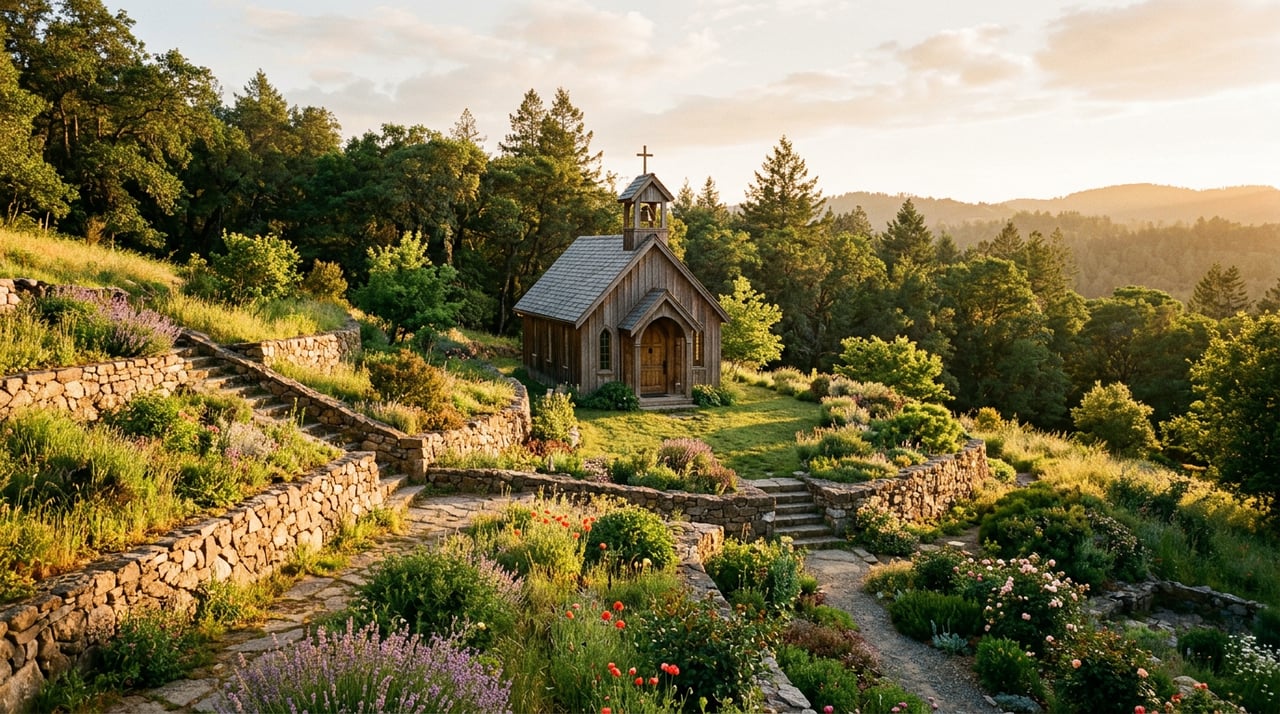
The amphitheater tucked into the hillside behind St. Columba's dates to 1965, when local historian Jack Mason built it, as the Point Reyes Light reported. The following year, the new Inverness Music Festival, organized as part of the Inverness Fair and run by Woodacre musician Rae McNally, staged its first concerts in the church and the outdoor venue. The opening night drew roughly 250 people to the bench seats, with latecomers standing on the hillside to hear a performance of Haydn's oratorio "Creation."
For the next decade, the amphitheater carried real programming. Audiences saw "The Bartered Bride" in 1970, then "Madame Butterfly," solo recitals, and a Bach mass in 1971. Molly Noble, who spent childhood summers in Inverness, remembered watching a performance of Mozart's "The Magic Flute" there.
The Point Reyes Light quoted Noble recalling: "It was pretty magical, as a kid, to see something like that in that intimate setting."
Then the run of full seasons ended, and the space spent decades falling into disrepair, mostly used, if at all, informally.
In 2015, Sharron Drake, who had produced "The Heiress" at the Dance Palace Community Center that spring, launched a crowdfunding campaign to bring the amphitheater back for a run of "Much Ado About Nothing." Her budget was specific: roughly $3,000 to clear weeds and fix the theater itself, $1,000 to cover six performances, and $800 for facilities rentals. Drake, who planned to play Beatrice, described the campaign at the time as the first phase of what she hoped would become a more established performance venue rather than a one-off revival.
It worked, at least well enough to keep the tradition alive at low volume for the next ten years. By the summer of 2025, the venue was hosting Shakespeare again, this time "A Midsummer Night's Dream," staged, according to the event listing, in the wooded setting surrounding the amphitheater. The productions were modest and occasional, but the space was functioning.
The issue wasn't the stage or the seating. It was the staircase connecting the parking lot to the amphitheater, worn down by a decade of use and weather. The Episcopal Diocese of California reported that, in the 2025-2026 cycle, the West Marin Fund awarded St. Columba's a $5,000 Organizational Effectiveness Grant specifically to rebuild that staircase and make the climb down to the theater safer.
Once the work started, it grew past the original scope. A separate donor funded additional renovation: the high steps running through the center of the seating area, and a full renovation of the amphitheater's mezzanine using flagstone. Volunteers cleared and scraped the ground, rebuilt pathways, and hand-carried roughly eight tons of road base in five-gallon buckets to connect the new grant-funded stairs to the rest of the site. Reclaimed stone went into the mezzanine. Donated cypress boards and benches were worked back into the seating.
Earlier in the summer, before that work wrapped, the band Wake the Dead played a concert in the space, a reminder that the amphitheater had already become useful again for informal community gatherings even mid-renovation.
This year's production is "Sick to Death," Geoff Hoyle's adaptation of Molière's "The Imaginary Invalid," produced by Sharron Drake Community Arts. Hoyle, an Actors' Equity Association member performing the play under the union's Members' Project Code, plays Argan, a self-declared invalid in 17th-century Paris who submits to the era's dubious medical treatments while his household tries to talk some sense into him. The run opened September 5 and continues through the following weekend.
A few practical notes if you're planning to go:
Line up the dates and a pattern emerges that has nothing to do with which play is on stage. Mason built the amphitheater in 1965. It ran strong through roughly 1971, then went quiet for decades. Drake's campaign revived it in 2015, with a specific budget and a six-performance run. Eleven years later, the thing that failed wasn't audience interest. It was a staircase, worn out by exactly the kind of decade-over-decade use that a working amphitheater generates.
That's the detail easy to miss if you only look at what's playing this month. The amphitheater's future doesn't hinge on whether "Sick to Death" draws a bigger crowd than "A Midsummer Night's Dream" did last year. It hinges on whether the next generation of West Marin residents notices when the stairs start to go, applies for the next Organizational Effectiveness Grant cycle, or shows up for a work party with a bucket. Twice now, that's exactly what's happened. There's no reason to assume it happens automatically a third time.
For anyone who lives close enough to walk down Sir Francis Drake Boulevard on a September afternoon, that's worth knowing before the next hillside gathering. The plays are what get advertised. The volunteers are what make the plays possible at all.
If you're weighing what it means to put down roots in a town where a sixty-year-old amphitheare gets rebuilt by hand rather than left to fall apart, B.G. Bates has spent decades working alongside the people who make decisions like that. Begin your West Marin story and connect with B.G. Bates.
B.G. is dedicated to her community and continues to be a known resource with a unique and knowledgeable perspective on all aspects of West Marin.